
- Resources
- /
- Why "Phishing Protection" Misses the Point
Why "Phishing Protection" Misses the Point
Blog·4 min read
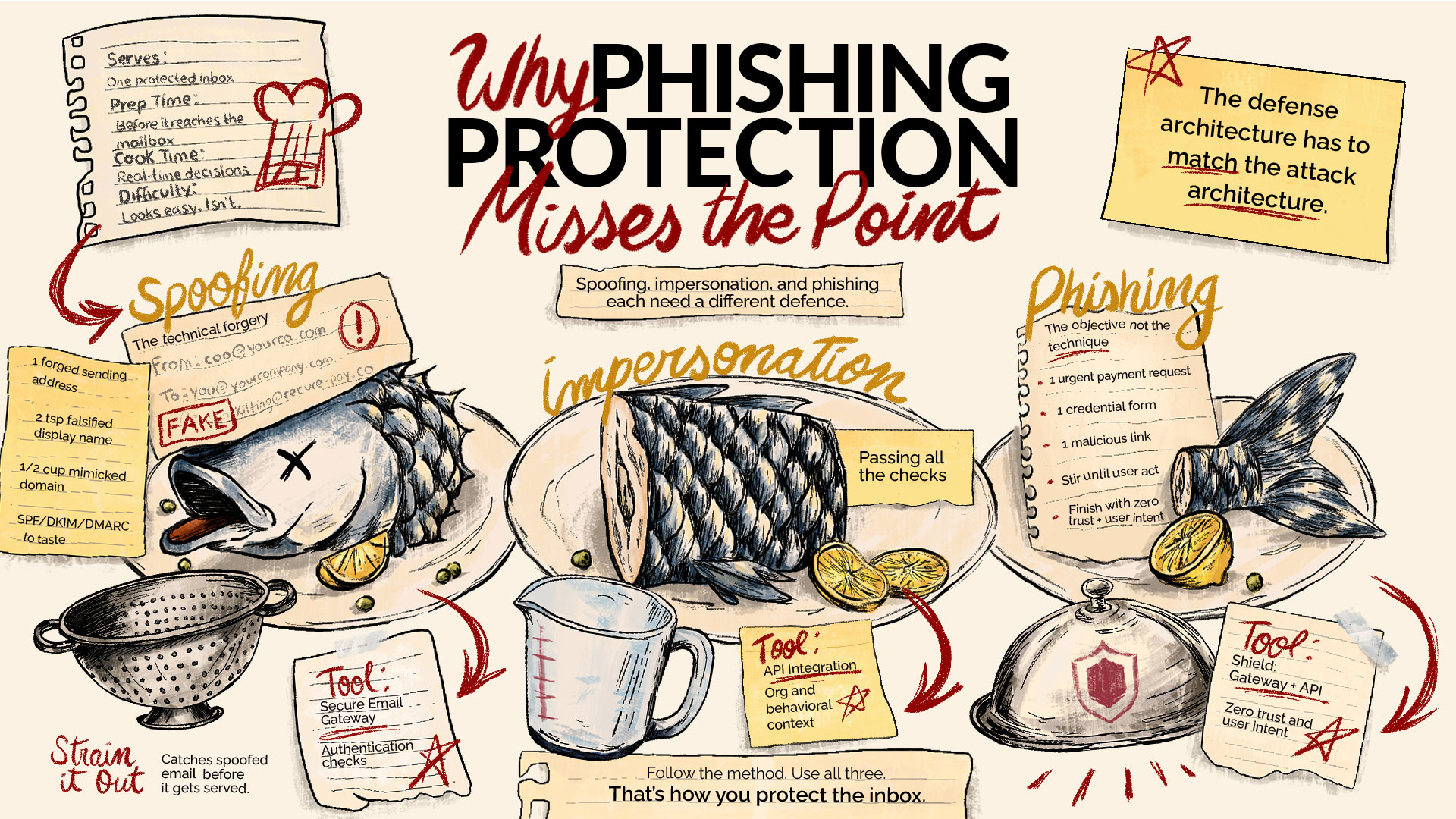
Every email security vendor offers phishing protection. It’s on every feature matrix, every product page, every pitch deck. The problem is that phishing isn’t one thing. Treating it that way creates the exact gap attackers exploit.
Spoofing, impersonation, and phishing are three distinct attack surfaces. They’re related, and attackers use them in combination, but each requires a different kind of defense. Collapsing them into a single category means you’re probably well-protected against one of them and leaving gaps in the other two.
Spoofing: the technical forgery
Spoofing is a data manipulation problem. A bad actor alters message data to make an email appear to come from a source it doesn’t—falsifying a display name, forging a sending address, or spinning up a server that mimics a legitimate domain.
A properly authenticated domain has SPF records that tell receiving servers which IPs are authorized to send on its behalf and DKIM signatures that allow recipients to verify message integrity. DMARC ties those two protocols together and gives domain owners a policy for what to do when a message fails those checks.
Because spoofing disrupts that authentication chain, it leaves behind technical evidence that can be detected and stopped automatically. Secure email gateways were built for this problem and excel at it. Spoofing is a technical attack met by technical defenses.
Impersonation: passing all the checks
Impersonation is where authentication alone becomes insufficient. While spoofing relies on technical forgery, impersonation relies on behavioral deception, and it often passes authentication checks entirely.
A threat actor who registers a domain like mailprotectorsupport.com, configures SPF and DKIM correctly, and sends from that domain will clear every standard authentication filter. The domain is real. The records are valid. The only problem is that it has nothing to do with the organization it’s imitating, and a recipient who doesn’t look closely may never know.
This is why impersonation is harder to address at the gateway layer. A gateway can verify that the sender is who their DNS records say they are. It can’t easily verify that the entity behind those records is who the message claims to represent. That requires organizational context: who communicates with whom, from where, and how consistently.
Phishing: the objective, not the technique
Phishing is the objective behind spoofing and impersonation. It’s the behavioral goal of getting a recipient to take an action—click a link, download a file, authorize a payment, hand over credentials.
This distinction matters because it shapes how the threat scales. A broad phishing campaign doesn’t require sophisticated impersonation. Volume and generic urgency are enough to get a percentage of recipients to act. At the other end is spear phishing: highly targeted, personalized to a specific individual, designed to be indistinguishable from legitimate communication.
The gap between those two has narrowed considerably. Generative AI can scrape public profiles, match someone’s vocabulary and communication patterns, and produce a convincing message in minutes. The FBI’s 2025 Internet Crime Report documented 22,364 AI-related complaints for the year, accounting for over $893 million in losses. The report explicitly flags that this figure is almost certainly low, because most victims don’t recognize when AI was involved in the attack against them.
Phishing complaints to the FBI declined slightly in 2025, while financial losses from phishing tripled—a signal that confirms attacks are becoming more targeted and more effective, not just more frequent.
Why the defense architecture has to match the attack architecture
Gateways excel at the spoofing problem: authentication checks, DMARC enforcement, perimeter filtering before anything reaches a mailbox. What they can’t supply is organizational context. A gateway doesn’t know your client’s vendors, their org chart, or how their CFO typically writes. It sees message data, not communication patterns.
API integrations with platforms like Microsoft 365 fill that gap, detecting behavioral deviations a gateway can’t see: a sender who always uses one mail server suddenly sending from another, a name that’s familiar but slightly off, a message that passes every filter but doesn’t match how that person has ever communicated before. But an API solution sitting alone has no perimeter. Threats arrive in the mailbox first, and remediation happens after the fact.
MSPs recognized this gap years ago, which is why many layered more modern API-based protection on top of traditional secure email gateways to close impersonation and behavioral detection blind spots. But stitching together tools from different vendors creates costly operational overhead: multiple licensing models, disconnected policy engines, overlapping investigations, and finger-pointing when threats slip through.
Mailprotector’s Shield is what that layered approach was always trying to be: technical defenses and behavioral analysis built as a unified system, sharing context and intelligence in real time.
The gateway stops threats at the perimeter. The API connects to the organizational directory and communication history. All that lands in the inbox is what actually belongs there. See the difference.
Ready to see what email security looks like when it's fixed?
Join thousands of MSPs who protect their clients with Mailprotector.